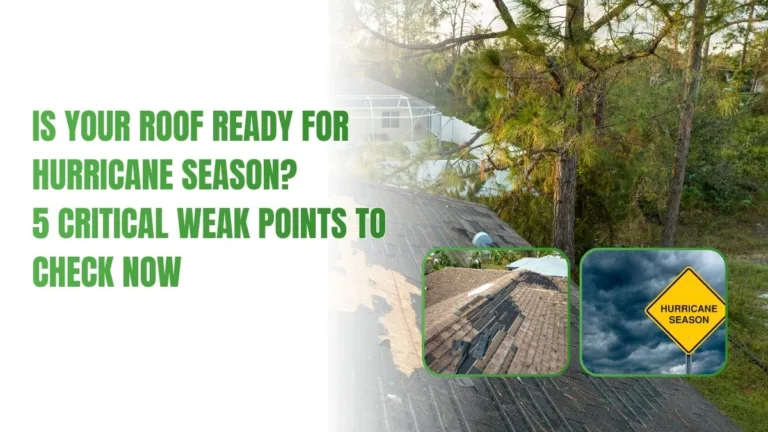
Hurricane season runs from June 1 through November 30 – and if you’re waiting until a storm is in the forecast to think about your roof, you’re already behind. According to the Insurance Institute for Business & Home Safety (IBHS), 70 to 90 per cent of all insured residential catastrophe losses stem from roof-related damage. That’s not a typo. Your roof is the single most consequential factor determining whether a storm displaces your family for days or months.
After studying roofs across dozens of post-hurricane investigations, IBHS researchers have consistently found the same truth: storm damage rarely happens all at once. It cascades. Wind and water find the smallest weakness, pry it open, and what started as a lifted shingle edge becomes soaked insulation, rotted decking, collapsed drywall, and a six-figure repair bill.
The good news? Most of the catastrophic failures they document were preventable. Here are the five critical weak points your roof needs to be checked before the first named storm of the season forms.
Weak Point #1: Your Shingles – Especially If They’re Ageing
This is where most hurricane damage begins. IBHS testing has confirmed that asphalt shingles – particularly older ones – can begin dislodging in winds as low as 60 mph. A minimal Category 1 hurricane brings sustained winds of 74 mph. That math is sobering.
The mechanism is a failed adhesive seal strip. Every asphalt shingle has a heat-activated adhesive strip along its lower edge designed to bond it to the shingle below. Over time – typically 10 to 15 years in Texas heat – these strips dry out, crack, and lose their grip. You won’t see this from the ground. But once a seal fails, that shingle is already lifting in normal wind. In hurricane-force conditions, it peels back, and the moment it does, it creates a pressure pocket under the adjacent shingles. One shingle failure becomes five, then twenty.
What to check:
- Walk your property and look for granules accumulating in gutters – granule loss signals shingle surface degradation, even if shingles appear intact from the ground
- Look for any curling edges, cracking, or shingles that appear slightly raised at the corners
- If your roof is 10+ years old and has never been professionally inspected, schedule one before June
After Hurricane Ian, IBHS researchers found that nearly half of asphalt shingle roofs in the impact zone had detectable damage – a statistic that echoed findings from Hurricane Charley nearly two decades earlier. Age and maintenance matter enormously.
Weak Point #2: Flashing – The Most Overlooked Failure Point
Flashing is the thin metal (usually aluminium or galvanised steel) installed wherever your roof meets a vertical surface – chimneys, vents, skylights, HVAC penetrations, dormers, and roof-to-wall transitions. Its job is to seal those joints so water can’t intrude. Under normal conditions, it does that job quietly and invisibly.
Under hurricane conditions, it fails loudly and expensively.
Post-hurricane inspections of damaged low-slope roofs found that more than 70% of damaged structures also had significant flashing damage. Even on steep-slope homes, flashing around penetrations is one of the first points where wind-driven rain enters. A storm can push water horizontally, sideways, or even upward – conditions no standard installation is designed to handle unless it’s been properly sealed and secured.
Old flashing corrodes. Sealant around penetrations dries out and cracks. Flashing that was improperly installed (a common issue in homes built before modern code enforcement) may only be held with roofing cement rather than mechanical fasteners.
What to check:
- Inspect sealant around all roof penetrations – chimneys, vents, pipe boots, skylights
- Look for rust staining on flashing, which signals deterioration
- Check step flashing along dormers and any roof-to-wall intersections for separation or lifting
- Any flashing that moves when you press it needs repair before storm season
Weak Point #3: Ridge Cap – Your Roof’s Most Exposed Strip
Stand at the peak of a roof during a hurricane, and you’re experiencing the highest wind loads anywhere on the structure. That peak is exactly where ridge cap shingles sit – a row of specially shaped shingles that cap the ridge line and seal the joint where two roof planes meet.
Ridge cap shingles are exposed on two sides to wind pressure simultaneously. When uplift forces act on the ridge, they’re pulling in two directions at once. Field inspectors consistently note that displaced ridge cap shingles are concentrated along perimeters and ridge lines – the areas of highest wind pressure – rather than scattered across the roof plane.
The consequences of a lost ridge cap extend far beyond cosmetics. The ridge line is the highest drainage point on your roof. Once it’s compromised, water pours directly into your attic with every rain band a storm produces, often for hours before you realise anything is wrong.
What to check:
- Use binoculars from the ground to inspect your ridge line for any lifted, cracked, or missing cap pieces
- Look for any sections where the ridge cap appears uneven or buckling
- If any ridge cap pieces have ever blown off and been replaced, ensure those replacements were properly nailed and sealed – quick patch jobs often lack the fastener count the original installation required.
Weak Point #4: Roof-to-Wall Connections – The Hidden Structural Risk
This one isn’t visible from outside your home, but it may be the most structurally critical item on this list. Your roof doesn’t just rest on your walls – in a properly built home, it’s mechanically connected to them via metal hurricane straps, clips, or clips that tie the roof framing to the wall framing and ultimately to the foundation.
When that connection is weak or missing, IBHS researchers describe what happens next: “Wind and rain enter your home, and it begins the cascade of damage where rain soaks your insulation, damages your drywall, and soaks your personal possessions – and that displaces families after hurricanes.”
Texas ranked near the bottom of IBHS’s most recent statewide building code assessment, in part because the state does not enforce a uniform statewide building code. Homes built in unincorporated areas, or built before modern codes, may have roof framing that was simply toenailed to the top plate – a connection that performs poorly under uplift loading.
What to check:
- If your home was built before the mid-1990s, ask a roofing or structural professional whether hurricane straps are present in your attic
- In the attic, look at where roof rafters or trusses connect to the top of the exterior walls – metal straps or clips should be visible.
- If you’re planning any re-roofing work, ask about adding or upgrading connection hardware – this is dramatically easier and cheaper to address when the roof is already being worked on
Weak Point #5: Gutters and Drainage – The Problem That Compounds Everything Else
Gutters might seem like a minor detail compared to structural shingles and flashing, but clogged or damaged gutters can turn a manageable storm into a full-scale interior water event. A hurricane doesn’t deliver 2 inches of rain – it can deliver 10 to 15 inches in 24 hours. A gutter system packed with debris becomes a holding vessel for enormous water volume, overflowing backwards against the fascia board and roof deck edge, saturating wood that was never designed to handle standing water.
That standing water doesn’t stay on the surface. It wicks under the drip edge, softens the fascia, penetrates the roof deck, and finds its way into the wall cavity. By the time you see a water stain on your ceiling, the wood behind it has been wet for a while.
There’s a secondary risk too: a gutter that has sagged, pulled away from the fascia, or corroded at the hangers is a projectile waiting for a strong enough gust to launch it. In high winds, detached gutters can damage siding, windows, and neighbouring property.
What to check:
- Clean all gutters completely and flush downspouts before storm season
- Check every hanger and bracket for tightness – press upward on gutter sections to feel for looseness
- Look for sagging sections, visible corrosion, or areas where the gutter has separated from the fascia
- If your gutters are more than 10 years old and showing deterioration, replacement before hurricane season is a sound investment
- Verify downspouts are directing water well away from the foundation – 6 feet minimum.
What Stronger Roofs Actually Look Like
Research from the IBHS FORTIFIED program – a voluntary beyond-code construction standard based on decades of post-storm investigation – shows that homes built or retrofitted to FORTIFIED standards suffered 35% fewer insurance claims after Hurricanes Matthew, Florence, Dorian, and Isaias compared to standard construction. Lab studies and real-world data show FORTIFIED standards can significantly reduce damage from winds up to 130 mph.
The upgrades involved aren’t exotic: sealed roof decks, enhanced fastening patterns, proper flashing installation, and verified roof-to-wall connections. The difference is attention to the weak points, properly addressed before the storm.
Steel and metal roofing systems also performed significantly better in post-Ian investigations, with damage rates near 12% compared to roughly 50% for asphalt shingles – a meaningful difference for homeowners considering long-term resilience.
Don’t Wait for the Forecast
The window between “storm season begins” and “storm is in the Gulf” can be measured in days. Contractors book out fast. Materials get allocated. The homeowners who come through hurricane season with the least damage are the ones who had professional eyes on their roof in April or May – not in the 72 hours before landfall.
If your roof hasn’t been professionally inspected in the last year, now is the right time. Apex Fencing & Roofing serves Central Texas homeowners with comprehensive pre-season roof inspections and storm damage repair. We’ll evaluate all five of these critical weak points, document what we find, and give you honest options before the first storm of the season has a name.
Call us at (254) 239-0434 or request your free inspection at apexfencingandroofing.us.