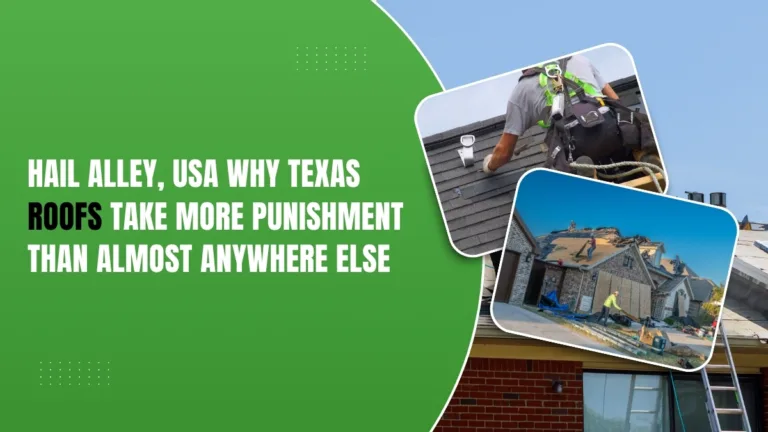
If you’ve lived in North Texas for more than a year, you already have a story about the sound hail makes on a roof. That’s not a coincidence, it’s geography.
Welcome to the Hail Belt
Meteorologists have a name for the corridor running from Texas up through Oklahoma, Colorado, and Wyoming: the Hail Belt. It exists because of a specific weather recipe: warm, moist Gulf air colliding with cooler air pushing down from the plains, over flat terrain that lets storm cells build without interruption. North Texas sits close to the middle of it, which is why Dallas, Tarrant, Collin, and Denton counties show up again and again at the top of the nation’s hail-claim rankings. According to the Insurance Information Institute, Texas doesn’t just rank near the top for hail-related insurance claims it ranks first, year after year.
The Numbers Are Bigger Than Most People Realize
This isn’t just dented gutters and cracked patio furniture. A single hail outbreak across the Dallas-Fort Worth Metroplex in June 2023 produced an estimated $7 to $8 billion in insured losses. Go back to April 2016, and a San Antonio hailstorm caused roughly $1.4 billion in damage in one afternoon. Industry estimates suggest that in any given five-year stretch, about one in ten Texas homes will file a hail-related insurance claim. Spring, specifically March through June is peak season, when temperature contrasts and Gulf moisture line up almost perfectly over North Texas.
Why This Matters for Your Roof Specifically
Hail doesn’t have to punch a hole in your roof to cause real damage. Impact bruises the asphalt mat, knocks protective granules loose, and softens the shingle’s ability to seal against wind and water none of which is obvious from the ground. A roof can look completely normal after a storm and still be compromised underneath, which is exactly why adjusters and roofers check for granule loss in gutters, dents on soft metal like vents and AC housings, and bruising you can feel more than see. It’s the same reason “if it’s not leaking, it’s fine” made our list of roofing myths Texas homeowners still believe: no visible damage doesn’t mean no real damage.
What Actually Holds Up Better
Not all roofing materials take a hail hit the same way. Impact-resistant shingles rated Class 4 under UL 2218 use a reinforced mat that resists cracking and granule loss significantly better than standard shingles, and many Texas insurers now offer meaningful premium discounts, sometimes 10–35% annually, for homes with them installed. If you’re due for a replacement anyway, it’s worth asking your roofer to walk you through Class 4 options before defaulting to standard shingles. For a full price comparison by material, see our 2026 Texas roofing cost breakdown.
It Hits Close to Home Too
Central Texas sits inside the same Hail Belt corridor, just south and west of the Metroplex. If you’re weighing a roof installation in Belton, a roof installation in Cameron, a roof installation in Copperas Cove, or a roof installation in Temple, that hail history is worth factoring into your material choice before you sign anything. And if a storm already found your roof, the same logic applies whether you need roof repair in Bartlett or ongoing roof maintenance in Cyclone.
The Bottom Line
If you’re in North Texas, hail isn’t a question of if but when. The best defense is knowing what your roof looked like before the last storm, getting it inspected after every significant hail event even if nothing looks wrong and choosing materials built for the corridor you actually live in.
One more thing worth knowing: major hail events also draw out-of-town crews looking to cash in fast before moving on to the next town. Before you sign anything with a contractor you’ve never heard of, take a look at our guide to spotting storm-chaser scams.
Worried the last storm did more damage than it looks like from the driveway? Apex Fencing & Roofing offers free roof inspections and hail damage roof repair after major weather events, serving Temple, Belton, Copperas Cove, Cameron, Bartlett, and Cyclone. Call (254) 239-0432 and get a second set of eyes on it before small damage turns into a bigger repair bill.