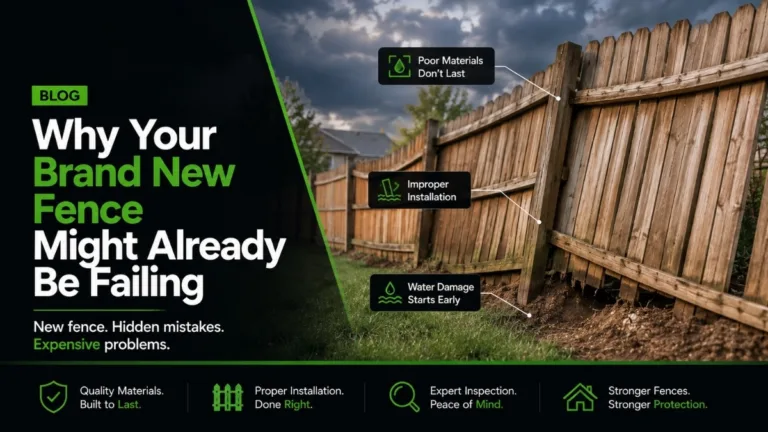
The fence installation was completed just three months ago. You paid good money for quality materials and professional work. But now you’re noticing posts leaning slightly, boards warping, or gaps appearing between panels. Your brand-new fence is failing, and you’re wondering why.
The answer usually involves installation choices made before a single board went up. While we primarily focus on roofing solutions, fence quality matters to neighborhood value. Understanding why new fences fail prevents expensive mistakes.
The Foundation Problem: Posts
Improper post installation causes most fence failures. Posts should be set at least 30% of their length in the ground, properly leveled, and set in concrete. Many installers cut corners here.
What we see:
- Posts set too shallow (just 24 inches for 6-foot fence)
- Posts set in soil without concrete (frost heaves cause movement)
- Posts not properly leveled (creates stress on boards)
- Improper concrete installation (water pooling around base)
Within months, these issues cause posts to shift, lean, and destabilize the entire structure. What looked perfectly straight in month one is noticeably crooked in month four.
Material Quality Deception
Here’s what homeowners don’t always understand: not all wood fence materials are equal. Some installers use untreated or improperly treated lumber that begins rotting immediately. Others use wood that’s still too wet, which warps as it dries.
Pressure-treated lumber should have specific retention levels. Some cheaper material doesn’t meet standards and fails quickly. The cheapest installation often means the cheapest materials too.
Improper Drainage and Grading
Fences adjacent to houses need proper grading to prevent water accumulation. If a new fence sits in soil where water pools or doesn’t drain properly, the wooden components begin rotting in months rather than years.
Poor drainage turns a new fence into a deteriorating structure almost immediately.
Climate-Specific Installation Failures
Central Texas presents specific challenges. Our temperature swings cause significant wood movement. Materials expand in heat and contract in cold. Installers who don’t account for this create joints too tight, which split as wood moves, or too loose, which gap as wood shrinks.
Proper installation accounts for these seasonal changes.
Hardware and Fastener Problems
Using inappropriate fasteners is another hidden cause of failure. Galvanized nails work fine. Cheap fasteners or improper fastener types cause problems:
- Nails that rust, creating structural weakness
- Fasteners that work loose as wood moves
- Fasteners that corrode and stain wood
- Improper fastener spacing causing board stress
Installation Sequence Errors
The order of installation matters enormously. Posts should be set and cured before boards are attached. Boards should be installed with appropriate spacing. Top rails should be installed to allow drainage.
Poor sequencing causes stress distribution problems that manifest as failure within months.
What to Look for in Quality Work
When comparing your “failing” new fence to properly installed work, quality installations include:
- Straight, level posts set deep in concrete
- Proper spacing between boards (accounting for seasonal movement)
- Appropriate fasteners in sufficient quantity
- Proper drainage around posts
- Top rails and caps that direct water away
- All wood treated appropriately for local climate
Prevention: The Inspection Standard
Before accepting a completed fence, thoroughly inspect:
- Post levelness and straightness (use a level)
- Post stability (apply pressure, they shouldn’t move)
- Fastener quality and spacing
- Adequate gaps between boards
- Proper water drainage
- Material quality verification
The Real Issue: Installation Contractor
Your fence isn’t failing because new fences are poor quality. It’s failing because installation quality varies. This is why professional contractors who understand local conditions and use proper techniques produce fences that last decades while contractor-shortcuts produce failures within months.
Whether it’s roofing or fencing, the contractor you choose determines whether you have a quality installation or a premature failure. Don’t make decisions based on the lowest price alone. Quality work whether it’s roof installation services in Georgetown or fence installation—costs more upfront but saves thousands in the long run.