Picking a fence feels easy until you actually start looking into it.
Then suddenly there are like ten different materials to choose from and everyone has a different opinion. Your neighbor swears by wood. Someone in a Facebook group says vinyl is the only way to go. A contractor tells you aluminum is the smartest investment.
So who is right?
Honestly, all of them are right depending on the situation. That is the part nobody tells you upfront. There is no single best fence material. There is only the best material for your specific yard, your budget, your climate, and what you actually need the fence to do.
Start Here: What Do You Actually Need From Your Fence
Before we even get into Wood vs Vinyl vs Aluminum Fence comparisons, ask yourself a few honest questions.
Do you need full privacy or just a boundary marker? Are you keeping pets or kids inside the yard? Do you care a lot about how it looks from the street? How much time are you realistically willing to spend on maintenance every year? And what is your budget not just for installation but for upkeep over the next ten years?
Your answers to those questions will point you toward the right material faster than any comparison chart will.
Now let us get into each one.
Wood Fences: The Classic That Everyone Knows
Wood is what most people picture when they think of a backyard fence. And there is a good reason it has been the go-to choice for so long. It looks warm. It feels natural. It fits into almost any yard style from a cottage garden to a modern minimalist space.
What wood does really well
Wood provides full privacy when the boards are placed close together. It is easy to customize. You can cut it to any height. You can space boards however you want. You can paint it any color or stain it to bring out the natural grain. If one board gets damaged, you can replace just that one board without touching the rest of the fence.
Wooden fence installation services are also widely available because it is such a common material. Most fence contractors work with wood regularly so finding someone experienced is not hard.
Wood is also relatively affordable upfront compared to some other options. If budget is tight right now, wood gets you a solid fence without a huge initial investment.
Where wood struggles
Maintenance is the big one. Wood needs attention. In a hot and sometimes humid climate, wood dries out, cracks, warps, and eventually rots if it is not treated regularly. Staining or sealing every one to three years is not optional if you want the fence to last. It is required.
Insects are another issue. Termites and carpenter ants love untreated wood. Using pressure-treated lumber for the posts is important, at minimum. Cedar and redwood have natural oils that resist insects better than basic pine.
A properly maintained wood fence can last 15 to 20 years. A neglected one might need replacing in half that time.
Who wood is best for
Wood makes the most sense for someone who wants a traditional, natural look, has a bit of time for regular maintenance, and wants design flexibility. If you like the idea of painting your fence a bold color someday or changing the stain to match a new exterior, wood gives you that freedom.
Vinyl Fences: The Low Maintenance Choice
Vinyl is made from PVC plastic. It is manufactured to look like wood, but it behaves completely differently. And for many homeowners, that difference is exactly what they are looking for.
What vinyl does really well
The main selling point is maintenance. Vinyl needs almost none. You do not stain it. You do not seal it. You do not treat it for insects. When it gets dirty, you hose it down, and it looks clean again. That is genuinely it.
Vinyl does not rot. It does not rust. Insects cannot damage it. It holds its color for a long time without fading as badly as painted wood does. For busy homeowners who do not want to think about their fence after it goes up, vinyl is very attractive.
It also holds up well against moisture. If your yard stays wet after rain or you have sprinklers running regularly, vinyl handles that without the concerns you would have with wood.
Where vinyl struggles
The upfront is higher than wood. Depending on the style and quality, vinyl can cost noticeably more per linear foot to install.
Color options are more limited than with wood. You get white, tan, gray, and a few other options but you cannot paint vinyl easily if you change your mind later. The color you pick at installation is essentially permanent.
In extreme heat, vinyl can expand and contract quite a bit. Cheap vinyl can warp or become brittle over time in very hot climates. This is why material quality matters a lot with vinyl. Going with a reputable brand and a contractor who knows what they are doing makes a real difference.
Vinyl also cannot be repaired as easily as wood. If a section gets damaged badly enough, you usually need to replace the whole panel rather than just one board.
Who vinyl is best for
Vinyl works really well for someone who wants a clean-looking fence and genuinely does not want to deal with maintenance. It is also great for areas with high moisture. If you have kids or pets and you want a solid privacy fence that you can basically ignore after installation, vinyl is a strong choice.
Aluminum Fences: The Elegant Low-Maintenance Option
Aluminum differs from both wood and vinyl in both how it looks and how it is used. It is not typically a privacy fence. It is more of a decorative boundary fence with open pickets.
What aluminum does really well
Aluminum does not rust. Ever. That is a big deal for a metal fence. Traditional iron fences are beautiful but they rust and need regular painting to stay that way. Aluminum gives you that classic, elegant look without any rust issues.
Aluminum fence installation services are popular for front yards, specifically because the open design lets people see the house from the street while clearly defining the property boundary. It looks polished and intentional without blocking the view.
Aluminum is also much lighter than steel or iron. That makes installation easier and puts less stress on the posts over time.
It holds powder coat paint finishes very well. Most aluminum fences come with a factory-applied powder coat that is really durable. Black is the most popular color, and it looks sharp against almost any house exterior. Other colors are available too.
Aluminum fences are also good for properties with slopes or uneven ground because they can be racked, allowing the panels to follow the land’s slope rather than step down in a staircase pattern.
Where aluminum struggles
Privacy is basically zero with a standard aluminum fence. The open picket design means anyone can see completely through it. If privacy is your main goal, aluminum is not the right choice.
It can also be bent or damaged by impact more easily than steel. A car bumping into it or a large branch falling on it can cause damage that needs panel replacement.
For security purposes, aluminum works as a deterrent and a boundary marker but it is not going to stop someone who is determined to get into your yard. The gaps between pickets are climbable and the material itself is not as robust as steel.
Who aluminum is best for
Aluminum is ideal for front yard boundaries, pool enclosures where local codes require fencing but you want something that looks nice, and any situation where you want a decorative fence that requires almost no maintenance. It is also great for properties with slopes since it handles uneven ground better than most other materials.
Putting It All Together: Wood vs Vinyl vs Aluminum Fence Side by Side
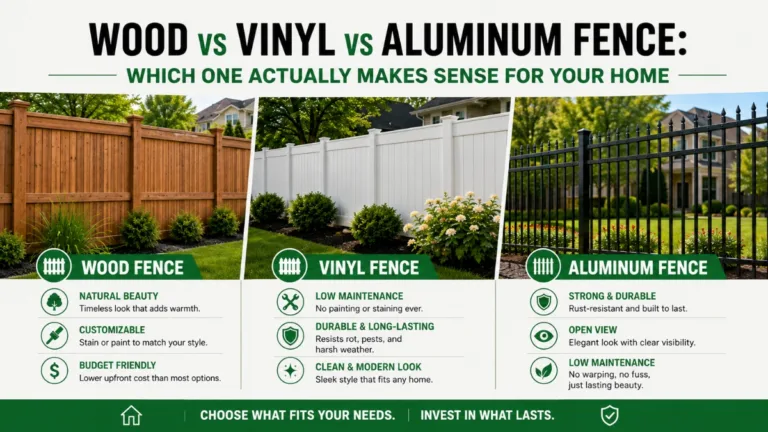
When you look at Wood vs Vinyl vs Aluminum Fence as a straight comparison, the differences become really clear. Wood gives you the most natural look and the most design flexibility. It costs less upfront but requires regular maintenance to stay in good shape. Best for privacy and for people who like a hands-on approach to their home.
Vinyl gives you a wood-like look with almost zero maintenance required. It costs more upfront but saves you time and money on upkeep over the years. Best for full privacy with minimal ongoing effort.
Aluminum gives you an elegant decorative fence that never rusts and looks sharp for years. Almost no maintenance needed. Not suitable for privacy but excellent for boundaries, curb appeal, and pool areas.
None of these is objectively better than the others. They just serve different needs.
What Homeowners Around Copperas Cove and Belton Are Choosing
In Central Texas, the climate plays a real role in these decisions. The heat is serious here. Summers are long and dry. That affects wood more than the other two materials. Wood in this climate needs more frequent treatment than it would in a cooler, wetter climate. That extra maintenance commitment is something homeowners need to honestly think about before choosing wood.
Vinyl holds up well in heat as long as quality materials are used. Cheaper vinyl products can have problems in extreme temperatures, so working with experienced fence contractors in Copperas Cove TX who know which products perform well locally is important.
Aluminum handles the Texas heat very well. The powder coat finish does not fade quickly in the sun, and the material itself is not affected by temperature changes the way wood is.
For anyone looking for fence builders in Belton, TX, local contractors can give you honest advice on what has performed best in the area over the years. Real local experience is worth a lot when making a material choice that will live outside in Central Texas weather for the next decade or two.
The Cost Reality Nobody Likes to Talk About
Upfront cost versus long-term cost is where many people make mistakes. Wood looks cheap at first. But add up staining every two years, occasional board replacements, and the possibility of needing a full replacement sooner if maintenance slips. The total ten year cost is often higher than people expect. Vinyl costs more on day one but the ten-year cost is usually lower because maintenance costs are basically zero. Aluminum sits in the middle depending on the style and quality of the panels chosen.
Fence installation service quotes should always include a discussion of long-term costs, not just the installation price. A good contractor will be honest about what each material actually costs to own over time, not just to install.
One Last Thing Before You Decide
Whichever material you choose, installation quality matters as much as material quality. Posts set at the wrong depth fail. Hardware that is not rated for outdoor use rusts and loosens. Panels installed without accounting for ground slope look bad and put uneven stress on the structure. The Wood vs Vinyl vs Aluminum Fence decision is important. But choosing an experienced installer is just as important as the material itself.