
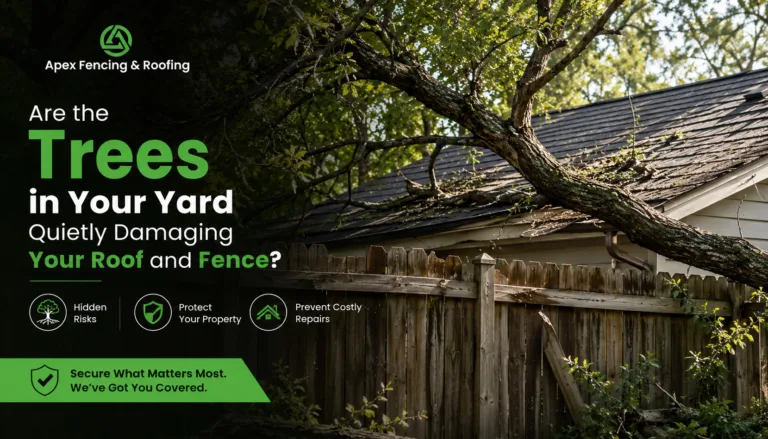
Trees are one of the best parts of owning a home in Central Texas. They cut the heat on a brutal August afternoon, add real curb appeal, and give a yard the kind of character that takes decades to grow. Most homeowners would never want to be without them.
But those same trees, left to grow without any attention, can work against your home in ways that are easy to miss until the damage is already serious.
Your roof and your fence are two of the most exposed parts of your property when it comes to tree-related problems. The tricky part is that neither the tree nor the early damage looks urgent. Until it does.
Here is what to watch for, and what you can do about it.
Overhanging Branches: The Slow Damage Nobody Notices
The most common tree-related issue is also the easiest one to overlook. Branches that hang directly over your roofline look harmless on a still day. But every time the wind picks up, those branches scrape back and forth across your shingles.
That repeated friction wears away the protective granule coating on asphalt shingles. Granules are what protect the underlying material from UV exposure and moisture. Once they are gone, the shingles beneath start to degrade faster, and water finds its way in sooner.
The same thing happens with wooden fences. Branches hanging close to your fence line rub against posts and panels during wind events, wearing down the surface and opening the wood up to rot.
The straightforward solution is tree trimming. Keeping branches cut back to a safe distance from your roofline and fence eliminates friction before it can cause damage.
Falling Limbs: When the Damage Happens Fast
Dead or dying limbs do not give much warning. They can drop during a storm, after heavy rain, or sometimes on a perfectly still afternoon when the wood has finally had enough.
A falling limb on your roof can crack or displace shingles, dent metal panels, punch through softer roofing materials, or compromise the structural decking underneath, depending on the size. Even a mid-sized branch can knock gutters loose or break a section of seamless gutter, clean off the fascia.
On a fence, a heavy limb drop can snap posts, break panels, and buckle metal sections. Corrugated metal and ornamental steel fencing are particularly vulnerable because the impact force concentrates in a small area rather than being distributed across a wider surface.
If you spot dead branches, limbs that lean at an odd angle, or sections of a tree that look hollow or discolored, that is a removal job, not a trimming job. Waiting on dead wood is not worth the repair bill it creates. Tree removal is the right call when the limb or the tree itself is structurally compromised.
Root Growth and Your Fence Posts
This is the problem that tends to get overlooked the most. As trees mature, their root systems spread outward, and those roots do not stop for fence posts.
Roots growing through the soil around your fence posts can gradually shift them out of alignment. Posts that were perfectly plumb when installed start to lean. The fence line buckles. In some cases, roots physically push up under post footings, causing the post to heave out of the ground.
If you have established trees running close to your fence line and your fence has started to lean without any obvious storm damage, root intrusion is worth investigating. A fence inspection can determine whether you are dealing with post movement, wood rot, soil erosion, or a structural issue at the base.
Leaf and Debris Buildup in Your Gutters
Your gutters have one job: move water away from your roofline and foundation. When leaves, seed pods, acorns, and small twigs pile up inside them, water has nowhere to go. It backs up, sits against the roofline, and eventually works its way under shingles or behind the fascia board.
In Central Texas, gutter clogging is not just a fall problem. Live oaks drop pollen, catkins, and acorns across spring and summer as well. If you have trees near your roofline, your gutters are collecting debris year-round.
Seamless gutters reduce the number of joints where debris can get stuck, but no gutter system clears itself. If you are seeing overflow during rain, water staining on your fascia, or pooling near your foundation, your gutters are telling you something is already blocked.
Shade, Moisture, and Moss
When a large tree creates a heavy canopy over a section of your roof, it blocks sunlight and traps moisture on the shingle surface. That combination is exactly the right environment for moss and algae to establish themselves.
Moss is not just a cosmetic issue. It holds moisture against the shingle surface and can lift the edges of shingle tabs, creating a path for water to get underneath. Over time, that trapped moisture degrades the shingles ahead of schedule and shortens the effective life of the roof.
Trimming back the heaviest overhanging branches improves airflow and allows sunlight to dry out the roof surface after rain. That alone is often enough to slow or stop moss growth without needing any chemical treatment.
What to Actually Do
None of this is inevitable. Staying ahead of it comes down to a regular walk around your property with some specific things in mind.
Look up at your roofline and check for branches that are close to or touching the surface. Walk your fence line and check any nearby trees, ensuring the posts are still straight and the fence line is still even. After the next rain event, check your gutters and watch whether water flows freely from the downspout.
If you find branches that are too close, trimming is the starting point. If you find dead limbs or a tree that looks structurally questionable, removal is the right next step. If the trees have already done damage to your roof or fence, a free inspection is the fastest way to get a clear picture of what needs to be addressed.
Trees and homes can share a yard without conflict. The key is just staying a step ahead of what is growing a little too close.