Most homeowners only think about their roof and fence when something goes visibly, obviously wrong. A missing shingle after a windstorm. A fence post that finally gave up and leaned into the neighbor’s yard. By then, the damage has usually been building quietly for months, sometimes longer, and what could have been a simple fix has turned into a much bigger conversation.
The good news is that your roof and fence have been communicating with you the whole time. The bad news is that most people do not know how to read the signals.
Here is what to look for before the next storm gives you no choice.
The Weather Nobody Is Fully Ready For
Central Texas does not ease into bad weather. It arrives. One week you are dealing with blistering heat that bakes shingles dry and warps wooden fence boards. The next, a fast-moving storm system rolls through with hail, sideways rain, and wind gusts that reveal every weak point in your property in a matter of minutes.
This is not a hypothetical scenario for homeowners across the region. It is a recurring reality. Families in Belton, Georgetown, and Bartlett have watched storm cells move through and left wondering what, exactly, just happened to their roof. Property owners in Cameron and Copperas Cove have dealt with fence sections down before the rain even stopped falling.
The homes that come through these events with the least damage share one thing in common. Someone looked before the storm hit, not after.
What Your Roof Is Actually Trying to Tell You
Walk to the end of your driveway and actually look at your roof. Not a quick glance. A real look.
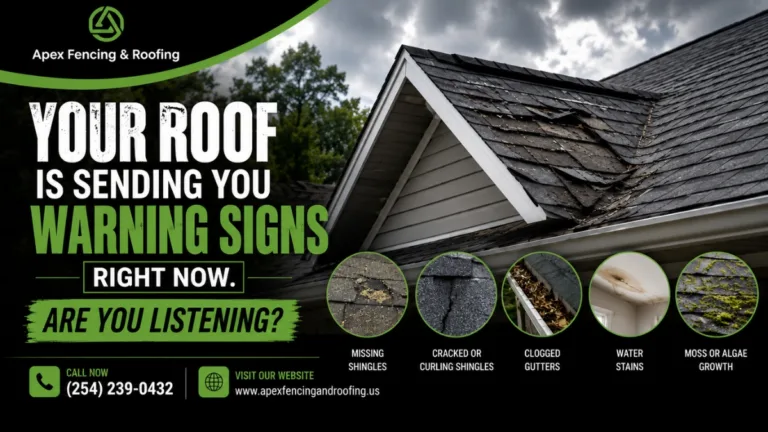
Do you see shingles that appear darker in some spots than others? That discoloration is often a sign of moisture sitting beneath the surface, trapped and working its way through the underlayment. Do any shingles look curled at the edges, almost like they are pulling away from the roof deck? That is weathering, and it is a sign your roof is losing its ability to shed water the way it was designed to.
Granule loss is another one that homeowners miss. If your gutters are filled with what looks like coarse dark sand after a rainstorm, those are granules from your asphalt shingles. They protect the material beneath from UV damage and heat. Once they are gone in volume, the aging process accelerates.
Sagging anywhere along the roofline is never a cosmetic issue. It points to structural concerns that need professional attention before the next weather event shows up uninvited.
None of this is rare. The team at Apex Fencing and Roofing sees these warning signs on homes in Bartlett, Copperas Cove, Cameron, and across the region regularly, particularly after a stretch of hot dry summers followed by a storm-heavy spring.
What Your Fence Is Trying to Tell You
Your fence handles the same weather as your roof, just from a different angle. While the roof deals with what falls from the sky, your fence takes the full force of wind from the side. Over time, that takes a toll that is easy to overlook.
Wooden privacy fences are particularly vulnerable. When wood absorbs moisture repeatedly and then dries out in the heat, boards begin to warp, crack, and split from the inside. Posts that were once set firmly in the ground start to shift, especially if the concrete around the base has cracked and allowed water to pool at the foundation.
After any significant storm, walk your entire fence line. If any section is leaning, wobbling, or has boards that have pulled away from the rails, those are structural issues that tend to get worse with every subsequent weather event. A fence that leans at a slight angle today can come down entirely in the next strong wind.
Metal and ornamental fencing have their own vulnerabilities. Surface rust, bent sections, and weakened welds at connection points are all signs the fence is losing integrity. Catching these early is almost always less expensive than dealing with a full failure.
Homeowners in Cyclone, Temple, and the surrounding communities deal with a combination of clay soil, temperature swings, and seasonal storms that ages fencing faster than many people expect going in.
The Compounding Problem Nobody Warns You About
Here is where things get more serious, and why this matters beyond just aesthetics.
Roof damage and fence damage rarely happen in complete isolation. A storm that tears shingles loose will often take fence panels with it. Debris carried by wind can land on fence sections and cause structural damage that is not immediately visible from a distance. And when gutters are damaged or disconnected, water that should be channeled safely away from your property ends up saturating the ground near your fence posts and your foundation.
Problems compound quickly. A small roof issue that leads to water intrusion can eventually show up in your walls, attic insulation, and even your foundation. A fence post sitting in saturated ground does not give you much warning before it fails. The homeowners who end up in the worst situations are almost always the ones who saw something minor and decided to wait.
Why Waiting Is the Most Expensive Choice You Can Make
There is a pattern that plays out constantly in residential roofing and fencing across Central Texas. A homeowner notices something minor. They decide to wait and see. The minor thing becomes a moderate thing. The moderate thing becomes a significant repair during a stretch when every contractor in the region is already booked because a major storm just moved through.
At Apex Fencing and Roofing, we work with homeowners throughout the region, including in Belton, Cameron, Georgetown, Copperas Cove, Bartlett, Cyclone, and Temple, to catch exactly these kinds of situations before they become expensive emergencies.
A free inspection does not obligate you to anything. It gives you information. It tells you where your roof and fence currently stand, what the risk areas are, and what actually needs attention now versus what can wait another season. That is useful to know regardless of what you decide to do with it.
What a Professional Actually Looks For
When an experienced contractor walks your property, they are not just looking at what you can see from the ground. They are checking the condition of flashing around your chimney and roof penetrations, areas where water commonly finds a way in first. They are looking at the ridge cap, which is often the first section to fail in a strong wind event. They are assessing whether gutters are pitched correctly and still securely attached to the fascia.
On the fence side, they are testing post stability, checking the connections at the rails, assessing the overall condition of the material, and identifying sections with structural concerns versus those that are purely cosmetic.
This is the difference between a casual glance and an actual assessment by someone who does this every day.
This Is the Easiest Step You Can Take Today
Central Texas weather is not waiting for you to get ready. The next round of storms, heat, or high winds will arrive on its own schedule. What you can control is how prepared your home is when it does.
If you have been putting off an inspection, or if you recognized any of the warning signs in this post, this is the right time to stop waiting. Apex Fencing and Roofing offers free property inspections for homeowners across Central Texas.
Call (254) 239-0432 or send a message to jeff@apexfencingandroofing.us to schedule yours.
Your roof and fence are already telling you something. It helps to have someone who knows how to listen.