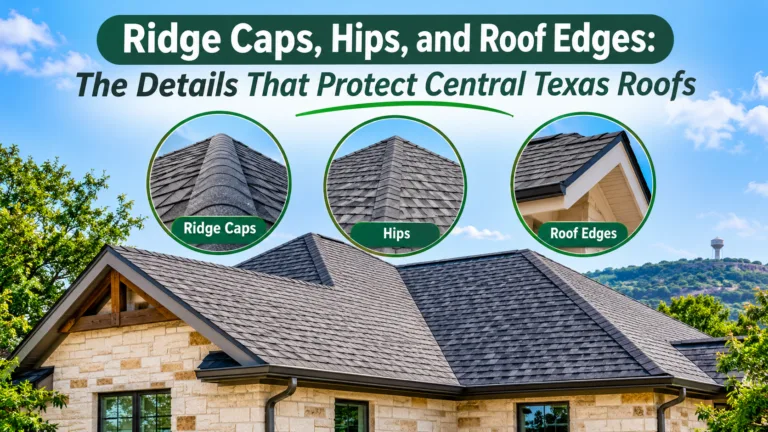
When people picture a roof, they usually think of the broad field of shingles that covers most of the surface. The edges and peaks deserve just as much attention. Ridge caps run along the top where two roof planes meet. Hips are the diagonal joints on a roof that slopes on all four sides. Rakes and eaves form the edges at the gable ends and along the lower perimeter. These details are where wind does its most aggressive work, and they are where water finds its way in when they are not built or maintained correctly.
Central Texas storms often arrive with strong gusts that lift and peel edge materials long before they damage the center of the roof. A roof that looks sound from the yard can still have loose caps, lifting edges, or failed fasteners along its perimeter. Knowing what these components do helps homeowners spot problems early and ask informed questions when repairs or replacement are planned.
What Ridge Caps Do
A ridge cap is a strip of shingle or specialty material bent over the peak of the roof. Its job is to cover the gap where the two slopes meet, shed water away from that joint, and provide a finished look. Because the ridge sits at the highest point of the roof, it takes the full force of wind coming over the top. The caps are fastened through both sides of the peak, and the fasteners and sealant must remain intact for the cap to hold. When ridge caps fail, the result is usually visible. Pieces may lift, curl, or blow off during a storm, exposing the underlayment below. Replacing ridge caps is typically a manageable repair if the underlying shingles remain sound. A contractor offering Roof Installation Services Belton can inspect the ridge during a routine assessment and recommend whether a targeted repair is enough.
Ridge Vents Versus Standard Caps
Many modern roofs use a vented ridge cap rather than a solid one. A vented cap allows attic air to escape along the entire peak while still shielding the opening from rain and debris. Vented caps work best when they are installed with the correct baffles and when the soffit intake is open and unobstructed. A solid cap installed over a ventilation opening will trap heat and moisture in the attic, so the choice between vented and solid caps should match the ventilation design of the roof. Homeowners sometimes replace a vented cap with a solid one during a repair without realizing the effect on attic airflow. Before making that change, ask whether the roof relies on ridge ventilation.
Hips and Their Vulnerabilities
Hip roofs have diagonal joints where two slopes meet at an angle. These hips are capped in much the same way as ridges, with shingles bent over the joint and fastened carefully. Because hips run at an angle, they can accumulate debris and water in a different pattern than straight ridges. Pine needles, leaves, and granules tend to collect in the low sections of hip caps, where moisture can linger. Inspect hips from the ground with binoculars at least once a year. Look for lifted caps, missing pieces, and gaps where the caps meet the field shingles. A roof repair crew that specializes in Roof Repair Services Harker Heights can check hips as part of routine maintenance.
Rakes and Gable Edges
The rake is the sloped edge of a gable roof, where the roof meets the wall at the end of the house. Rake edges are usually finished with a metal drip edge and a row of shingles or trim pieces that overhang slightly. Wind can lift these edges easily because they are exposed on the side of the house. When rake edges fail, water can run behind the trim and reach the fascia and sheathing below. Correct installation of the drip edge matters. It should extend under the underlayment at the eave and over it at the rake, so that water is directed away from the wall. Poorly installed edges are a common source of hidden damage that appears only after repeated storms.
Eaves, Drip Edge, and Fascia
The eave is the lower edge of the roof, where water drains off toward the gutters. A metal drip edge protects the roof perimeter by guiding water into the gutter and keeping it from running backward under the shingles. The fascia board behind the gutter supports the gutter and the roof edge. Together, these components form the transition between the roof and the rest of the house. Problems at the eave often start with a gutter that has pulled away or a clogged channel that forces water to back up. Water then runs under the drip edge and rots the fascia and the ends of the roof deck. Regular gutter maintenance is one of the simplest ways to protect the eave. A Roof Installation Services Killeen provider can inspect the eave and drip edge during gutter or fascia work.
Choosing Materials for Edges and Caps
Ridge caps are typically made from the same material as the shingles, though specialty products are also available. Metal drip edges are usually aluminum or galvanized steel, chosen for durability and ease of installation. Choosing materials that are compatible with the roof system matters, because mismatched components can wear at different rates. Ask your contractor which products are proposed and whether they are rated for the wind exposure at your property.
Color matching also affects appearance. Ridge caps that do not match the field shingles can stand out and make the roof look patched. A good contractor will select caps that blend with the existing or new roofing.
Signs That Edge Details Need Attention
Look for shingles that have lifted or curled near the edges, metal drip edge that has bent or separated, and fascia boards that show paint blistering or soft wood. Check the gutters for granules, which can signal that shingles near the eave are wearing. From inside the attic, look for staining on the underside of the roof deck near the eaves and rakes, since water intrusion at the perimeter often shows up there first.
After any significant storm, walk the perimeter of the house and look at the roof edges from ground level. Photographs taken at that time can document damage and support any insurance review if needed.
Repair Timing and Costs in Context
Edge and cap repairs are generally less involved than full roof replacement, but timing still matters. A lifted ridge cap that is left in place can allow wind to tear off more shingles. A failed drip edge can let water damage the fascia, which then requires more extensive carpentry. Addressing edge problems promptly keeps repairs focused and reduces the chance that they spread. When comparing proposals, ask whether the quote includes the ridge, hips, rakes, and eaves, or only the field shingles. Missing edge work is a frequent reason homeowners discover additional costs after a project begins.
Working With a Qualified Crew
Edge work demands careful measurement, correct fastening, and attention to how each piece interacts with its neighbors. A crew that understands the sequence of underlayment, drip edge, shingles, and caps will produce a more durable result. Ask how the contractor plans to address the ridge, hips, and eaves, and request photographs of similar completed work if you are unsure. Coordination with other exterior trades can also help. If fence or gutter work is happening at the same time, the crews can plan access so that edge details are not damaged during construction.
Keeping the Edges Sound
The ridge, hips, rakes, and eaves are the parts of the roof most exposed to wind and weather. Keeping them secure is one of the most cost-effective forms of roof care. Inspect them each season, keep gutters clear, and address lifted pieces quickly. A Fencing Company in Temple can help coordinate exterior projects that touch the roof edge, such as gutter installation near a fence line. Homeowners who want a complete review of roof edges along with fence work can also consult a fence contractor in Temple and a Roof Repair Services Temple provider, so that both the roof and the surrounding property are planned together.